Refusing Breath Test in South Carolina
A traffic stop can go from stressful to life-changing in a matter of minutes. If you are facing a DUI investigation, refusing breath test in South Carolina is not a simple yes-or-no decision with no consequences. It can affect your license immediately, shape the evidence in your case, and create problems that continue long after the roadside stop is over.
The most useful thing to understand is this: a refusal does not automatically end the DUI case, and it does not automatically make the case unwinnable either. It changes the battlefield. That is why what happens in the next few days matters just as much as what happened on the side of the road.
What refusing breath test in South Carolina usually means
South Carolina has implied consent laws. In plain English, that means when you drive in this state, you are considered to have agreed to submit to certain chemical testing if you are lawfully arrested for DUI and the officer follows the legal process.
Many people use the phrase “breath test” to describe several different things, but they are not all treated the same way. South Carolina rarely uses a handheld roadside test, but any roadside breath test is different from the Implied Consent-based Datamaster breath test typically given after arrest. That distinction matters because the legal consequences can depend on when the Implied Consent test was requested, was the person properly advised of their rights, and whether the officer had legal grounds for the arrest.
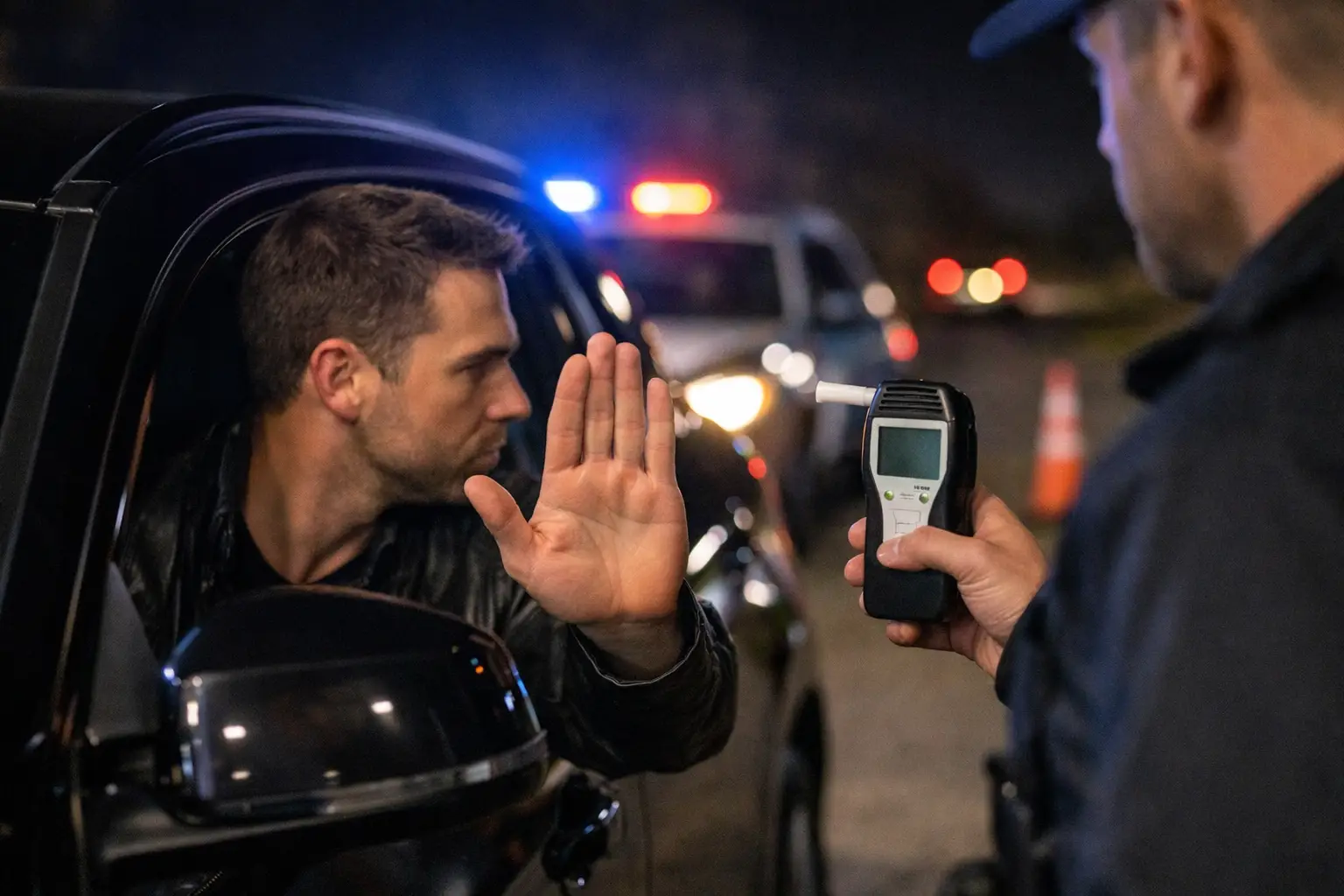
If you refuse a post-arrest breath test requested under South Carolina’s implied consent law, your driving privilege must be suspended for at least six months, with the option of ending the suspension by enrolling in the Ignition Interlock Device Program. The officer is also required to tell you that your refusal may be used against you in court. The refusal can also become part of the prosecution’s case. In other words, the state may argue that the refusal shows consciousness of guilt, while the defense may challenge whether the stop, arrest, warning, and testing request were handled lawfully. At the administrative hearing, the issues can include whether the person was lawfully arrested or detained, whether the implied-consent rights were properly given in writing and verbally, whether the person refused testing, and, in test-result cases, whether the testing was properly conducted.
Refusal does not erase a DUI charge
A lot of people assume that if there is no breath number, there is no DUI case. That is not how these cases work.
A prosecutor can still pursue DUI based on the officer’s observations, driving pattern, field sobriety tests, body camera footage, statements made during the stop, and any other evidence collected. If there was an accident, open containers, or witness statements, that evidence may also matter. So while a refusal can deprive the state of one piece of evidence, it does not take the case off the table.
At the same time, the absence of a breath result can limit the prosecution in meaningful ways. Without a chemical test result, the state may rely more heavily on subjective observations, and that opens the door to careful scrutiny. Were the officer’s instructions clear? Did fatigue, anxiety, a medical condition, or uneven pavement affect field sobriety performance? Was the arrest actually supported by probable cause? Those questions can become central.
The license suspension issue comes fast
For many people, the most immediate damage is not the court date. It is the threat to the driver’s license.
If you refuse a post-arrest implied-consent breath test, the officer may issue a notice of suspension that immediately triggers an administrative suspension through the DMV, separate from the criminal DUI case. Under South Carolina law, a refusal can result in a suspension of at least six months, with possible ignition-interlock options depending on the facts and timing. That means you may have two different problems moving at the same time: the criminal charge in court and the license issue through the administrative process. They overlap, but they are not the same.
You generally have 30 days from the issuance of the notice of suspension to request a contested case hearing. If you request the hearing on time, you may be able to obtain a Temporary Alcohol License while the hearing is pending or pursue an ignition-interlock path. If you do not request the hearing, or if the suspension is upheld, ADSAP enrollment becomes part of the process.
That means you may have two different problems moving at the same time: the criminal DUI charge in court and the administrative license issue through the DMV/Office of Motor Vehicle Hearings. They overlap, but they are not the same.
Was it really a refusal?
Not every alleged refusal is as clear as it sounds.
Sometimes a person is confused by instructions. Sometimes there is a language issue, a hearing issue, a medical problem, asthma, anxiety, dental work, or another physical reason a breath sample was not successfully completed. Sometimes a driver asks questions and the officer treats hesitation as refusal. In other cases, the implied consent warning may not have been given correctly, or the arrest itself may be subject to challenge.
That is why a refusal case should be reviewed carefully instead of accepted at face value. The label “refusal” can sound final, but the actual facts often deserve much closer attention.
The officer still has rules to follow
In DUI cases, procedure matters. A lawful outcome for the state depends in part on lawful steps by law enforcement.
The stop must be valid or at least defensible under the Fourth Amendment. The arrest must be supported by probable cause. The implied consent warning must be properly handled. The implied-consent advisement should also tell the person that they have the right to obtain an additional independent test at their own expense. The request for testing must fit within the legal framework. If any part of that chain breaks, the defense may have strong arguments about suppression of evidence, the weight of the refusal, or the validity of the suspension.
This is where former-prosecutor insight can matter. A defense lawyer reviewing a refusal case is not just asking whether the client said no. The real question is whether the state can prove the legal foundation for everything that came before and after that moment.
What penalties are at stake?
The answer depends on the facts. Prior record matters. Whether there was an accident matters. Whether there are other charges matters. Whether the case involves a first offense or a repeat allegation matters.
On the refusal side, the immediate concern is often the suspension of driving privileges. On the criminal side, a DUI conviction can affect insurance, work, professional reputation, background checks, and family obligations. For some clients, driving for work is nonnegotiable. For others, the greater concern is keeping the case from expanding into a long-term problem that follows them at every job application.
A refusal can also affect how the case is negotiated and presented. Sometimes the absence of a breath result gives the defense more room to challenge proof. In other cases, the surrounding evidence is still strong, and the case needs to be approached with realism and strategy from day one.
What to do after refusing a breath test
The biggest mistake is waiting and hoping it sorts itself out.
Write down what happened as soon as you can still remember it clearly. Note why you were stopped, what the officer said, whether field sobriety tests were given, what warnings were read, whether you asked questions, and whether there were medical or physical issues affecting your ability to provide a sample. Save any paperwork. Do not guess about deadlines.
Then speak with a DUI defense lawyer quickly. A good early case review can identify issues that get harder to prove later, especially once body camera footage, dispatch records, maintenance records, or witness memories start to fade into the background of a busy court system.
If your case is in York County, Lancaster County, Chester County, or nearby courts, local practice can also matter in practical ways. The law is statewide, but courtroom habits, scheduling realities, and the way DUI cases move through a particular jurisdiction can affect defense planning.
Common misconceptions about refusing breath test in South Carolina
One of the most common misconceptions is that refusal is always the best move. Another is that refusal is always the worst move. Both are too simplistic.
Some people refuse because they think it prevents the state from proving intoxication. Others comply because they believe refusal automatically makes them look guilty. Real cases are more complicated than either assumption.
There are situations where the lack of a chemical result may create meaningful evidentiary issues for the state. There are also situations where a refusal creates separate license consequences and still leaves enough evidence for a prosecution to move forward confidently. The right defense strategy depends on the actual facts, not internet folklore or advice passed around after someone else’s case.
Why early defense work changes the case
A DUI case starts taking shape immediately. By the time many people begin looking for help, the officer’s version of events is already in the report, the DMV process is moving, and critical deadlines may be close.
Early defense work means examining the stop, the arrest, the warning, the testing request, the video, the timeline, and the practical impact on your life. It means looking for legal weaknesses without ignoring real-world risks. It also means building a plan that protects more than the court file – your license, your job, your schedule, and your future options.
That kind of preparation matters whether the case ultimately calls for negotiation, litigation, or a hearing focused on your driving privileges. Carolina Criminal Defense approaches these cases with that broader goal in mind: defending your future, not just reacting to paperwork.
If you refused a breath test, do not assume the case is over, and do not assume the damage is already done. Get the facts reviewed while there is still time to do something useful with them.