Field Sobriety Test Review in DUI Cases
A DUI stop can feel decided before you ever get to court. The officer writes that you “failed” roadside tests, and suddenly that part of the report starts sounding like the whole case. But a careful field sobriety test review often tells a different story. These tests are not as simple, objective, or reliable as many people assume, and how they were given matters.
If you were arrested for DUI in South Carolina, roadside testing deserves close attention early. Not just because it appears in the police report, but because judges, prosecutors, and juries may treat it as proof of impairment unless the defense shows where the process broke down. That review is not about making excuses. It is about separating observation from assumption.
Why a field sobriety test review matters
Field sobriety tests are designed to help an officer decide whether further DUI investigation is justified. They are not medical exams, and they are not foolproof measurements of intoxication. In practice, they are often administered on the side of the road, at night, with flashing lights, traffic noise, anxiety, and uneven pavement working against the driver.
That context matters. A person can look unsteady because of age, back pain, fatigue, nerves, footwear, weather, or a medical condition. A person can misunderstand instructions even while sober. An officer can also overstate what happened, especially when the report is written after the arrest decision has already been made.
A strong review looks at whether the officer followed training, whether the conditions were fair, and whether the observations actually support impairment. Sometimes the issue is not one dramatic flaw. It is several smaller problems that make the roadside testing much less persuasive than it first appears.
What officers usually look for during field sobriety tests
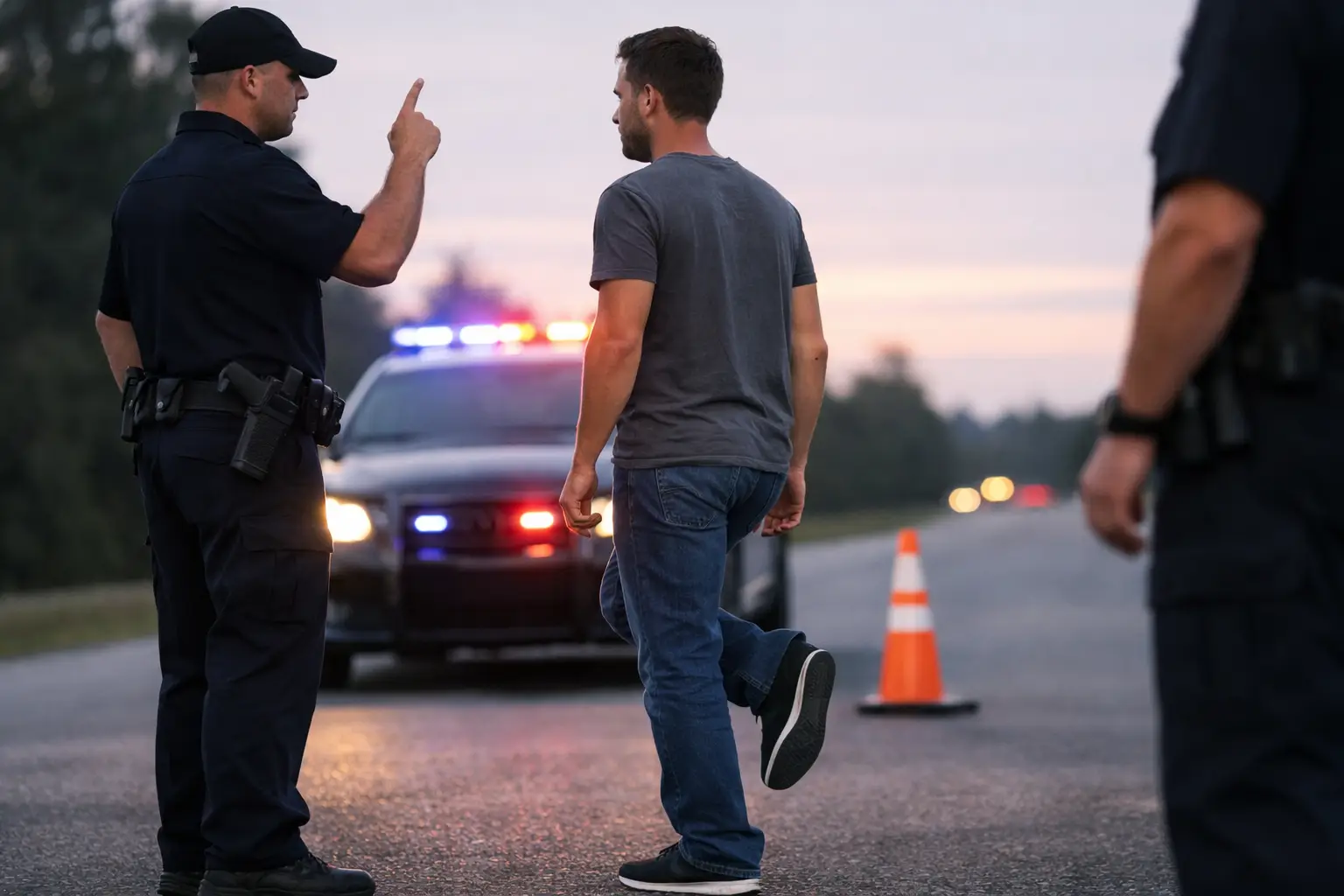
Most DUI investigations involve some combination of the horizontal gaze nystagmus test, the walk-and-turn, and the one-leg stand. These are the standardized tests most commonly associated with DUI stops. Officers are trained to look for specific so-called clues during each one.
On paper, that sounds structured. In the real world, the tests still depend heavily on the officer’s judgment. Did the driver step off line, or was there no clear line to follow? Did the driver raise arms for balance because of impairment, or because the shoulder was uneven gravel? Did the officer give complete instructions and allow the driver to ask questions, or rush through the process?
This is where details matter more than labels. Saying someone “failed” a test is a conclusion, not a fact. The meaningful question is what actually happened and whether those observations were recorded accurately.
The tests are standardized, but the roadside is not
Standardization only helps when the officer follows the procedure correctly and the testing conditions are reasonably suitable. Many DUI arrests involve sloped roads, poor lighting, boots or work shoes, injuries, and drivers who are older, overweight, or dealing with completely unrelated physical limitations.
Even the gaze test can be affected by improper positioning, moving patrol lights, or the officer using the stimulus incorrectly. The walk-and-turn and one-leg stand can become less reliable when the person has knee problems, balance issues, or a job that leaves them exhausted at the end of a long shift. Those are not technicalities. They go directly to whether the test result means what the State claims it means.
What a defense lawyer looks for in a field sobriety test review
A proper review starts with the police report, body camera footage, dash camera footage, and any available booking videos. Video is especially important because reports often summarize behavior in conclusory language. Footage may show a driver who was polite, coherent, and physically stable despite the written claim that they appeared obviously impaired.
The next step is comparing the officer’s actions to the expected testing protocol. Were instructions given clearly and demonstrated when appropriate? Was the driver asked about injuries or medical issues? Was the surface level and safe? Was the person interrupted, distracted, or tested in traffic conditions that would affect anyone’s performance?
A lawyer also looks at timing and internal consistency. If the officer says the driver had slurred speech, bloodshot eyes, poor balance, and obvious confusion, does the video match that? If the driver allegedly could not follow simple instructions, were they still able to produce documents, answer questions clearly, and comply with directions? These inconsistencies can matter a great deal in negotiations and in court.
Medical and personal factors are often ignored
One of the most common problems in DUI cases is that normal human limitations get treated like signs of intoxication. Inner ear issues, old sports injuries, surgeries, neuropathy, anxiety, and certain medications can all affect balance, coordination, or eye movement. So can age and body type.
That does not mean every roadside test is invalid. It means the result has to be interpreted carefully. If the officer did not ask the right questions or chose to test someone in conditions that made success unlikely, the value of those tests drops.
How field sobriety tests fit into the larger DUI case
Roadside tests are rarely the only evidence in a DUI case, but they often shape everything that follows. The officer’s decision to arrest, request breath testing, or describe the driver as impaired may be tied closely to the field tests. If those tests are weak, the rest of the case may look weaker too.
That said, every case is different. If there is a very high breath result, a poor roadside testing process may not end the case by itself. On the other hand, if the chemical test evidence has issues, or if the DUI charge is built mainly on officer observations, a strong challenge to field sobriety testing can become central to the defense.
This is why early case assessment matters. Waiting too long can mean losing access to video, witnesses, or other evidence that helps put the stop in context.
What people often misunderstand about roadside testing
Many drivers assume they have no way to challenge field sobriety tests because the officer is trained and the report sounds official. That is not how criminal defense works. Training does not make an officer infallible, and a report is not the final word on what happened.
Another common misunderstanding is that nervousness should not matter. In reality, nervousness matters a lot. Most people are anxious during a traffic stop, especially when they suspect arrest is possible. Anxiety can affect listening, counting, balance, and eye contact. A fair review has to account for the fact that the average person is not performing these tests in a calm environment.
There is also a tendency to treat field sobriety tests as scientific proof. They are not. They are investigative tools that must be examined critically, just like any other piece of evidence.
What to do after a DUI arrest involving field sobriety tests
Start by preserving information. Write down what you remember about the stop, the road conditions, your shoes, any injuries, what the officer said, and whether you were given clear instructions. Those details are easy to forget, and they may become important later.
Then get your case reviewed quickly by a defense lawyer who handles DUI cases regularly. A real review is not just reading the arrest warrant and guessing how things might go. It means examining the testing process, the video, the officer’s wording, and how all of it fits with the chemical test evidence and the law.
For people in South Carolina, especially in busy local courts where DUI dockets move fast, early defense work can change the direction of the case. Carolina Criminal Defense approaches these cases with that in mind from day one – not assuming the officer got it right, and not treating roadside tests as untouchable.
A DUI charge can put your license, your job, and your reputation under pressure very quickly. But a field sobriety test review may show that the most damaging part of the State’s story is not nearly as solid as it first appears. If roadside tests played a role in your arrest, do not treat them as settled facts. Treat them as evidence that needs to be tested too.