Bench Trial Versus Jury: Which Trial Is Right?
A criminal case can turn on who decides the facts. The choice of a bench trial versus jury is not about picking the option that sounds faster or more favorable. It is a strategic decision shaped by the charge, the evidence, the court, and the risks that matter most to your future.
For someone facing a DUI, drug charge, assault allegation, theft accusation, or another criminal charge in South Carolina, the question may arise after negotiations have not produced an acceptable resolution. Before deciding, your defense lawyer should assess the evidence, identify legal weaknesses, and explain what each trial setting means in practical terms.
What Is the Difference Between a Bench Trial and a Jury Trial?
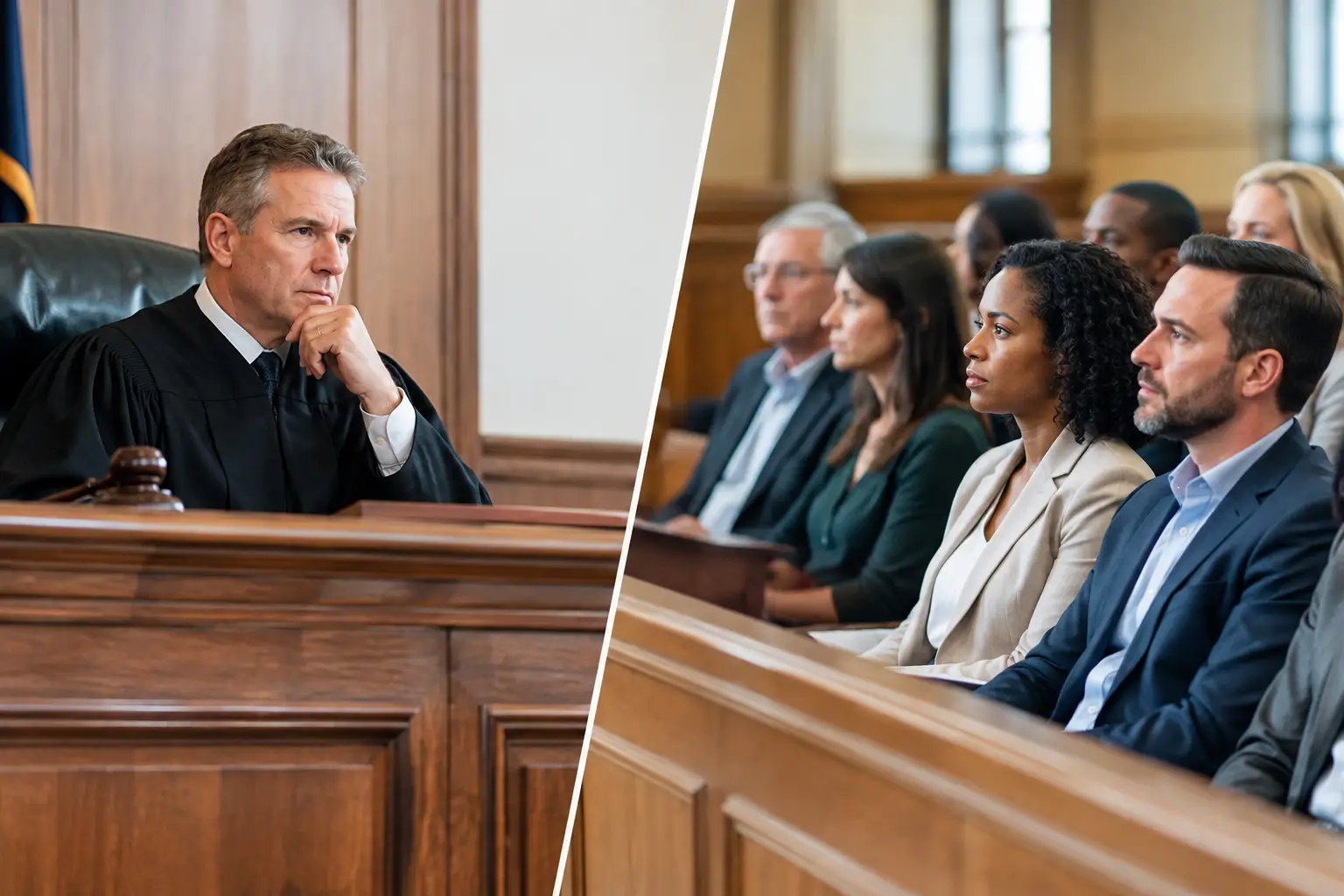
In a bench trial, the judge decides whether the prosecution proved the case beyond a reasonable doubt. The judge hears witness testimony, reviews admitted evidence, rules on legal objections, and delivers the verdict.
In a jury trial, a group of community members decides guilt or innocence while the judge manages the law, courtroom procedure, and evidentiary rulings. Jurors listen to testimony and arguments, receive legal instructions from the judge, then deliberate privately before returning a verdict.
The prosecution carries the same burden of proof in either setting. A defendant does not have to prove innocence. The State must prove every required element of the charge beyond a reasonable doubt, and a defense strategy should hold the State to that burden from the beginning.
When a Bench Trial May Make Sense
A bench trial may be worth considering when the case centers on a narrow legal or technical issue that a judge can evaluate without the emotional pull that may affect a jury. For example, the dispute may focus on whether a police stop was lawful, whether an officer followed required procedures, whether the State can establish a particular element, or whether a witness’s account is internally consistent.
Judges regularly hear testimony from law enforcement officers, forensic analysts, and other professional witnesses. They are accustomed to sorting through technical evidence and separating relevant proof from courtroom drama. In the right case, that can be an advantage.
Bench trials may also be more efficient than jury trials. There is no jury selection process, and the presentation of evidence may be more focused. Efficiency alone, however, is rarely a sufficient reason to waive a jury. A shorter trial is not necessarily a better trial if the facts would be understood more favorably by a group of jurors.
A judge may be less influenced by an emotional presentation, but that cuts both ways. If the defense has a compelling human explanation for why an event unfolded as it did, a jury may be more receptive to that context. The question is not whether judges or jurors are better. It is which fact finder is better positioned to fairly assess the particular case.
When a Jury Trial May Be the Better Choice
A jury trial can be especially valuable when credibility is the central issue. If the case depends heavily on one witness’s memory, an officer’s interpretation of events, a disputed identification, or conflicting accounts from the people involved, a jury brings multiple perspectives to the evaluation.
Jurors are not legal professionals, but they bring common sense and life experience into the deliberation room. A working parent, a business owner, a retiree, and a young professional may each notice different gaps in the evidence. The requirement that jurors deliberate can force the State’s evidence to withstand close discussion rather than relying on one person’s assessment.
A jury may also be the stronger forum when the prosecution’s presentation risks oversimplifying a complicated situation. In an assault case, for instance, the context of self-defense, alcohol use, prior conflict, or witness bias may matter greatly. In a DUI case, jurors may need to understand the difference between observations that sound suspicious and evidence that actually proves impairment beyond a reasonable doubt.
That does not mean a jury will automatically be more sympathetic. Jurors can have strong reactions to allegations involving drugs, violence, weapons, or impaired driving. A defense lawyer must account for the facts that will concern jurors, not just the facts that help the defense.
The Risks of Choosing a Jury
Jury trials usually require more time and preparation. Jury selection itself can reveal attitudes that may affect how evidence is received. Both sides have an opportunity to question potential jurors, but no lawyer can know exactly how any group will deliberate once the courtroom door closes.
A jury also makes its decision collectively. In many criminal cases, that means the prosecution must persuade all required jurors to convict. If even one juror has a reasonable doubt, the case may not end in a conviction. But a lack of agreement can also lead to a mistrial, leaving the State with the option to pursue the case again.
The decision should never rest on broad assumptions such as juries are always better for defendants or judges are always tougher. Those assumptions can lead to bad decisions. The evidence, local court practices, available defenses, and the way the case is likely to be presented all deserve careful analysis.
South Carolina Procedure Can Affect Your Options
Whether a bench trial is available can depend on the court handling the charge and the procedural rules that apply. In South Carolina, some cases are handled in magistrate or municipal court, while more serious offenses proceed in Circuit Court. The type of charge and the potential penalties can affect the right to a jury, jury size, and the process for waiving a jury trial.
A defendant should not assume that requesting a bench trial is simply a matter of personal preference. A valid jury waiver must be handled correctly, and the court’s procedures matter. In some circumstances, the prosecutor’s position and the judge’s approval may also affect whether the case can proceed without a jury.
This is one reason early case assessment matters. By the time a trial date is approaching, there may be critical decisions about witnesses, motions, expert review, video evidence, subpoenaed records, and trial format. Rushing that analysis can limit options that should have been considered much earlier.
Evidence Should Drive the Trial Decision
The most useful question is not, Would I rather have a judge or a jury? It is, What does the State have, and where does that evidence fail?
A disciplined defense review looks at the full record: body-camera video, dash-camera footage, dispatch recordings, police reports, witness statements, laboratory evidence, photographs, prior statements, and the timeline of events. In a DUI case, that may include the reason for the traffic stop, roadside observations, field sobriety testing, breath-test issues, and video that either supports or contradicts the officer’s report.
In a domestic violence or assault case, the review may focus on injuries, 911 calls, inconsistent accounts, self-defense evidence, messages between the parties, and whether witnesses saw the incident or only heard about it afterward. In a drug case, the central issue may be possession, knowledge, the legality of a search, or the chain of custody.
Once the real disputes are clear, the choice between a judge and jury becomes more grounded. A case with a precise legal issue may call for one approach. A case that turns on credibility, context, and reasonable doubt may call for another.
Do Not Treat Trial Format as an Isolated Decision
The decision between a bench trial and a jury trial belongs within a larger defense plan. It should be considered alongside pretrial motions, negotiation strategy, witness preparation, collateral consequences, and the possibility of alternative resolutions.
For many people, the consequences extend beyond the courtroom. A conviction can affect employment, professional licensing, driving privileges, family responsibilities, immigration status, firearm rights, and public reputation. That is why the trial decision must account for the full picture, not just the next court date.
A careful lawyer will explain the strengths and vulnerabilities of both options in plain English, then prepare as though the case will be tried. The right choice is the one supported by the evidence, the law, and a clear understanding of what is at stake. When your future is on the line, that decision deserves more than a quick answer in the hallway outside the courtroom.