
How the DUI Arrest Process Works in South Carolina
A DUI arrest can turn an ordinary drive home into a sequence of fast decisions with lasting consequences. Understanding how DUI arrest process works in South Carolina can help you avoid mistakes, protect key deadlines, and recognize when legal action needs to begin.
The process is not one event. It is a chain of decisions by law enforcement, the DMV, prosecutors, and the court. What happens at the roadside can affect your driver’s license. What happens after booking can affect bond conditions, work, and the evidence available to challenge the charge.
The Traffic Stop Starts the DUI Investigation
A police officer generally needs a lawful reason to stop a vehicle. That reason might be an alleged traffic violation, equipment issue, accident investigation, or report of impaired driving. A DUI stop does not automatically mean the officer has proof of impairment.
Once the stop occurs, the officer will observe details such as driving behavior, speech, balance, appearance, odor of alcohol, statements, and the condition of the vehicle. Routine questions can quickly become an impairment investigation. The officer may ask where you have been, whether you have consumed alcohol or medication, and whether you are willing to perform roadside tests.
Be respectful, provide required identifying documents, and do not argue at the roadside. At the same time, you do not have to volunteer a detailed account of your evening. Statements made under pressure can become part of the State’s case, even when they are incomplete or misunderstood.
Field Sobriety Tests and Preliminary Breath Tests
An officer may request standardized field sobriety tests, often including eye-movement testing, a walk-and-turn test, and a one-leg stand. These tests are designed to give the officer observations to support an arrest decision. They are not medical examinations, and they can be affected by injury, footwear, fatigue, uneven pavement, weather, age, anxiety, or an officer’s instructions.
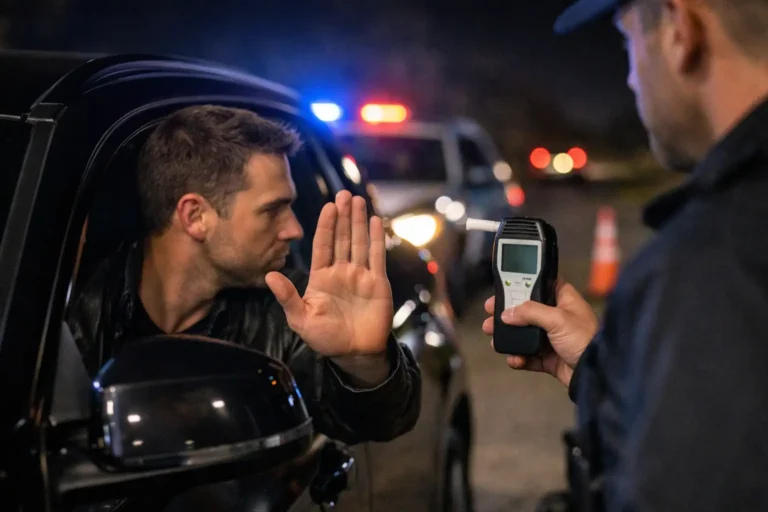
An officer may also ask for a preliminary breath test before an arrest. This roadside device is different from the breath test typically administered after arrest. Whether a driver takes or declines a roadside test can involve legal considerations, but the immediate point is that the officer is gathering information to decide whether probable cause exists.
Arrest, Handcuffs, and Booking
If the officer believes there is probable cause for DUI, the driver may be placed under arrest. Handcuffs, a patrol-car ride, and a trip to a law enforcement facility are understandably upsetting, especially for a first-time defendant. An arrest is serious, but it is not a finding of guilt.
At the facility, officers typically conduct booking. This may involve confirming identity, taking photographs and fingerprints, searching personal property, and documenting the charge. The agency may also check for outstanding warrants or other issues that can complicate release.
From this point forward, assume that your words and conduct matter. Phone calls may be recorded, interactions can be documented, and comments to officers or other detainees may later be repeated. Stay calm and ask to speak with an attorney as soon as you can.
South Carolina’s Chemical Test Procedure
After a DUI arrest, South Carolina’s implied-consent law becomes central. A driver who operates a vehicle in the state is considered to have consented to chemical testing under certain circumstances after a DUI arrest. The test may involve breath, blood, or urine, depending on the situation.
For many alcohol-related DUI arrests, the officer will request a breath sample on an approved machine. Before requesting the test, the officer should provide an implied-consent advisement. This warning addresses the consequences of refusing the test, the potential license suspension, and the right to obtain an additional independent test at the driver’s expense after submitting to the State’s test.
The details matter. Was the advisement properly given? Was the required testing procedure followed? Was the machine operating properly? Was the observation period adequate? Were recordings preserved? A chemical-test number can be significant evidence, but it does not answer every legal question in a DUI case.
Refusing a Chemical Test
A refusal can trigger an immediate license issue separate from the criminal DUI charge. It can also become evidence in the criminal case. But a refusal does not mean the prosecutor automatically has a stronger case, and taking a test does not mean the case cannot be defended.
The right response depends on the facts, including whether there was a crash, an injury allegation, a prior record, a blood draw, or other evidence of impairment. What should not wait is addressing the administrative deadline that follows a suspension notice.
Bond Release and Immediate Restrictions
After booking, a judge or magistrate may set bond. Depending on the circumstances, release may occur the same day, later that night, or after a court appearance. Bond conditions can include a promise to appear, restrictions on alcohol or controlled substances, no-contact provisions, or other requirements.
A DUI arrest can also create immediate practical problems. Your vehicle may have been towed. You may need a ride home, time away from work, or help arranging child care. If your license is suspended, do not assume you can continue driving as usual. Driving while suspended can create a separate charge and make an already difficult situation worse.
The License Suspension Has Its Own Deadline
One of the most urgent parts of how the DUI arrest process works is that the driver’s license case can move faster than the criminal case. If you are served with a notice of suspension for refusing a chemical test or for a qualifying breath-test result, there may be a limited period to request an administrative hearing and seek a temporary alcohol-restricted license.
Missing that deadline can leave you without options that may otherwise have been available. The specific paperwork matters, as do the date of service and the type of suspension alleged. Keep every document you receive from law enforcement, the DMV, towing company, and court.
For a working parent, sales professional, nurse, contractor, or student, a license suspension can be as disruptive as the court charge itself. Early legal review should address both tracks, not just the upcoming court date.
What Happens in DUI Court
The criminal DUI case begins with the charge and proceeds through the local court system. The exact path depends on the charge level, court jurisdiction, and facts. A first-offense DUI without serious injury is often handled differently from a felony DUI allegation involving great bodily injury or death.
Early court proceedings may focus on bond, scheduling, and representation. The case may later involve discovery, motions, negotiations, hearings, and potentially a trial. Prosecutors must still prove the charge beyond a reasonable doubt. The officer’s conclusion is not the final word.
A meaningful defense review examines the full timeline: the reason for the stop, video footage, roadside instructions, field-test conditions, officer reports, chemical-test records, dispatch information, and statements. In some cases, the central issue is whether the stop or arrest was lawful. In others, it is whether the evidence actually proves impairment beyond a reasonable doubt. Sometimes the most important work is identifying missing, inconsistent, or unreliable evidence.
What to Do After a DUI Arrest
The first days after an arrest are not the time to rely on memory alone. Write down what happened while details are fresh: where you were stopped, what the officer said, what tests were requested, when you were arrested, and whether there were cameras or witnesses. Do not post about the arrest online or discuss case details broadly with friends or coworkers.
Gather your paperwork and get legal advice promptly. A defense lawyer can assess the license deadline, preserve evidence, explain the charge and likely court process, and help you make decisions without guessing. At Carolina Criminal Defense, the focus is on building a clear strategy early because delay can affect both evidence and driving privileges.
A DUI charge can feel like your life has been reduced to a police report and a breath result. It has not. Take the process seriously, protect the deadlines in front of you, and get a clear assessment before making choices that may follow you long after the arrest.